 Home
Home Latest images
 Register
 Log in


Russia's helicopters in the East will receive technical support
18/11/2009
Company "Helicopters of Russia" and Airfreight Aviation of the United Arab Emirates established a joint service company International Rotorcraft Services, writes the newspaper Kommersant. Company "Helicopters of Russia" and Airfreight Aviation of the United Arab Emirates established a joint service company International RotorCraft Services, writes the newspaper Kommersant . the agreement was announced during an international air show in Dubai Dubai Airshow 2009. the agreement was announced during an international air show in Dubai Dubai Airshow 2009. Now the company is engaged in the modernization of helicopters, foreign customers. Now the company is engaged in the modernization of helicopters, foreign customers.
The joint venture will engage in maintenance of the Mi-8 and Mi-17 Mi-171 in the Middle East, including Iraq and Afghanistan. The joint venture will engage in maintenance of the Mi-8, Mi-17 and Mi-171 in the Middle East, including Iraq and Afghanistan. Now servicing of helicopters in the region engaged in the service center of Ulan-Ude Aviation Plant. Now servicing of helicopters in the region engaged in the service center of Ulan-Ude Aviation Plant. This plant will be part of a joint venture with the UAE. This plant will be part of a joint venture with the UAE.
According to General Director of "Helicopters of Russia Andrei Shibitova, the new venture will provide service only to those helicopters that are used to transport problems. According to General Director of "Helicopters of Russia Andrei Shibitova, the new venture will provide service only to those helicopters that are used to transport problems. In the first stage the company can service 20-50 cars a year by the end of 2010 - the beginning of 2011. In the first stage the company can service 20-50 cars a year by the end of 2010 - the beginning of 2011. According Shibitova, Russia's latest aviation technology is widely used in the East, especially the coalition forces in Afghanistan. According Shibitova, Russia's latest aviation technology is widely used in the East, especially the coalition forces in Afghanistan.
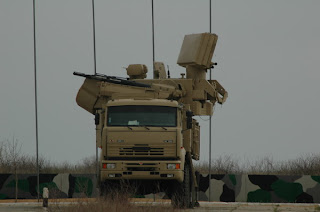
As the Kommersant "Dubai Airshow 2009 on was also announced that Russia began to supply the UAE air defense missile-gun complexes" Pantsir-C1 "developed in the early 1990's. As the Kommersant, on the Dubai Airshow 2009 was also announced that Russia began to supply the UAE air defense missile-gun complexes "Pantsir-C1" developed in the early 1990's. Such complexes are designed for air defense of stationary and mobile objects, covering anti-aircraft missile systems long-range, but is also capable of engaging surface targets. Such complexes are designed for air defense of stationary and mobile objects, covering anti-aircraft missile systems long-range, but is also capable of engaging surface targets.
Pantsir-S1 is equipped with 12 missiles and two double-barreled 30 millimeter cannon with 1,400 rounds of ammunition. Pantsir-S1 is equipped with 12 missiles and two 30-millimeter cannon double-barreled machine gun with 1400 rounds. Range hit targets up to 20 kilometers, and the height - up to 15 kilometers. Range hit targets up to 20 kilometers, and the height - up to 15 kilometers.
On signing the contract to supply the UAE, "shell" became known in May 2000. On signing the contract to supply the UAE, "shell" became known in May 2000. Initially, the delivery systems would be implemented from 2003 to 2005, but was later transferred to the years 2006-2009. Initially, the delivery systems would be implemented from 2003 to 2005, but was later rescheduled for 2006-2009. The reason for this was a requirement of the UAE to develop a new radar, capable of escort and ground targets. The reason for this was a requirement of the UAE to develop a new radar, capable of escort and ground targets.
Earlier, during the Dubai Airshow Air Show 2009 "Rosoboronexport confirmed that Russia is negotiating with Libya to sell fighter brand Su and transport IL-76. Earlier, during the Dubai Airshow Air Show 2009 "Rosoboronexport confirmed that Russia is negotiating with Libya to sell fighter brand Su and transport IL-76. In addition, it was reported that India may extend the order for the carrier-based fighter MiG-29K. In addition, it was reported that India may extend the order for the carrier-based fighter MiG-29K.
lenta.ru
18/11/2009
Company "Helicopters of Russia" and Airfreight Aviation of the United Arab Emirates established a joint service company International Rotorcraft Services, writes the newspaper Kommersant. Company "Helicopters of Russia" and Airfreight Aviation of the United Arab Emirates established a joint service company International RotorCraft Services, writes the newspaper Kommersant . the agreement was announced during an international air show in Dubai Dubai Airshow 2009. the agreement was announced during an international air show in Dubai Dubai Airshow 2009. Now the company is engaged in the modernization of helicopters, foreign customers. Now the company is engaged in the modernization of helicopters, foreign customers.
The joint venture will engage in maintenance of the Mi-8 and Mi-17 Mi-171 in the Middle East, including Iraq and Afghanistan. The joint venture will engage in maintenance of the Mi-8, Mi-17 and Mi-171 in the Middle East, including Iraq and Afghanistan. Now servicing of helicopters in the region engaged in the service center of Ulan-Ude Aviation Plant. Now servicing of helicopters in the region engaged in the service center of Ulan-Ude Aviation Plant. This plant will be part of a joint venture with the UAE. This plant will be part of a joint venture with the UAE.
According to General Director of "Helicopters of Russia Andrei Shibitova, the new venture will provide service only to those helicopters that are used to transport problems. According to General Director of "Helicopters of Russia Andrei Shibitova, the new venture will provide service only to those helicopters that are used to transport problems. In the first stage the company can service 20-50 cars a year by the end of 2010 - the beginning of 2011. In the first stage the company can service 20-50 cars a year by the end of 2010 - the beginning of 2011. According Shibitova, Russia's latest aviation technology is widely used in the East, especially the coalition forces in Afghanistan. According Shibitova, Russia's latest aviation technology is widely used in the East, especially the coalition forces in Afghanistan.
As the Kommersant "Dubai Airshow 2009 on was also announced that Russia began to supply the UAE air defense missile-gun complexes" Pantsir-C1 "developed in the early 1990's. As the Kommersant, on the Dubai Airshow 2009 was also announced that Russia began to supply the UAE air defense missile-gun complexes "Pantsir-C1" developed in the early 1990's. Such complexes are designed for air defense of stationary and mobile objects, covering anti-aircraft missile systems long-range, but is also capable of engaging surface targets. Such complexes are designed for air defense of stationary and mobile objects, covering anti-aircraft missile systems long-range, but is also capable of engaging surface targets.
Pantsir-S1 is equipped with 12 missiles and two double-barreled 30 millimeter cannon with 1,400 rounds of ammunition. Pantsir-S1 is equipped with 12 missiles and two 30-millimeter cannon double-barreled machine gun with 1400 rounds. Range hit targets up to 20 kilometers, and the height - up to 15 kilometers. Range hit targets up to 20 kilometers, and the height - up to 15 kilometers.
On signing the contract to supply the UAE, "shell" became known in May 2000. On signing the contract to supply the UAE, "shell" became known in May 2000. Initially, the delivery systems would be implemented from 2003 to 2005, but was later transferred to the years 2006-2009. Initially, the delivery systems would be implemented from 2003 to 2005, but was later rescheduled for 2006-2009. The reason for this was a requirement of the UAE to develop a new radar, capable of escort and ground targets. The reason for this was a requirement of the UAE to develop a new radar, capable of escort and ground targets.
Earlier, during the Dubai Airshow Air Show 2009 "Rosoboronexport confirmed that Russia is negotiating with Libya to sell fighter brand Su and transport IL-76. Earlier, during the Dubai Airshow Air Show 2009 "Rosoboronexport confirmed that Russia is negotiating with Libya to sell fighter brand Su and transport IL-76. In addition, it was reported that India may extend the order for the carrier-based fighter MiG-29K. In addition, it was reported that India may extend the order for the carrier-based fighter MiG-29K.
lenta.ru



.jpg)